
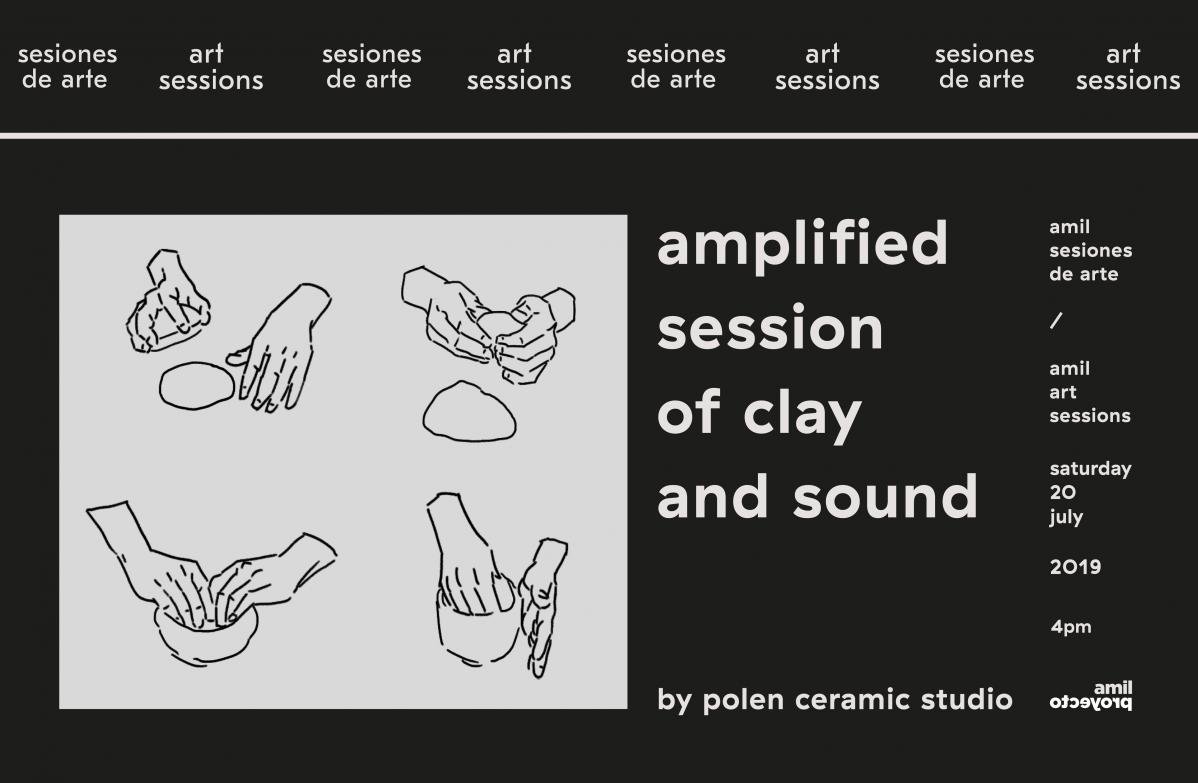
Saturday 20 July 2019
4pm – 6pm
Proyecto AMIL
Lima
For the ninth edition of AMIL- Art Sessions, Polen ceramic studio –a collective represented on this occasion by artists Frances Munar and Elizabeth Vásquez– will present Amplified Session of Clay and Sound. Based on the review of techniques used in the construction of simple sound amplifiers–such as the antara, the whistle and the trumpet– the session will explore how the body and its movement are instruments able to produce form, vibration and sound in contact with clay. Through clay and a performative game, participants will experience what it means to be a body that generates sound.
Members of the public of all ages are welcome to the session. No technical skill or previous experience is required. It is recommended to bring light clothes and be prepared to move. The session has a maximum capacity of fifteen participants.
To reserve a space, please write to: info@proyectoamil.org and polenconstrucciones@gmail.com
AMIL- Art Sessions is a series of monthly encounters at Proyecto AMIL aimed to expand artistic and curatorial practice beyond the temporal and spatial limitations of exhibition making. Throughout this series Proyecto AMIL seeks to promote alternative ways to talk about and experience contemporary art; as well as create a platform for exchange between artists, curators, researchers and our local audience.
Polen ceramic studio (Lima) researches and shares ceramic processes through different activities that form part of an educational program. Under this platform, in 2017, the artists Frances Munar and Elizabeth Vásquez organized a program of revision and dissemination of ancestral techniques. This investigation focused on the concept of sound ceramics in ancient Peru, leading to the development of workshops, conversations, sound activations and individual artistic projects.
Frances Munar (Lima, 1990). Her practice is based on a continuous exploration of the body as a forgotten vessel that enables and formulates new ways of understanding. Munar studies the sound in the pre-Columbian world by proposing it as a healing space. She maintains an interest in the heritage, identity and the tension between high and popular art. She was part of the Matadero Residency– El Ranchito– a co-production with AECID and Proyecto AMIL during ARCO Madrid 2019; as well as the Uberbau House Residency Program in Sao Paulo, Brazil, 2018. Her most recent collective exhibitions include: Dar forma al tiempo at the Museum of Contemporary Art–MAC (Lima, 2019); Generación Y at Y Gallery (Lima, 2017); Hacer llorar al instrumento at Ch.ACO (Santiago, Chile, 2017); La voz que se oye/deja oír at the Amano Museum (Lima, 2018). She co-produced the sound ceramic program in Polen ceramic studio in 2017-2018, where she has developed sound ceramic workshops, as well as initiatives centred on the revaluation and diffusion of ancestral techniques. Her first solo show A través de una línea fronteriza was part of Art Lima 2018, for which she won the Ca.Sa award.
Elizabeth Vásquez Arbulú (Lima, 1990). Her work is based on found objects and archives, which she replicates, records or deconstructs in installations where an interest in architecture, geography and archaeology, in relation to sociocultural symbols, is displayed. Vásquez’ practice is accompanied by a constant exploration and contrast of local craft techniques and digital media. She has participated in group shows such as: VideoTranslaciones (Madrid, 2019); 20° SESCVIDEOBRASIL (Sao Paulo, 2017); and Hawapi 2017: Triángulo Terrestre (Santiago de Chile and Lima, 2018 – 2017). Solo shows or interventions include: Proyecciones de Tierra (2016) and Colecciones de un código temporal (2018). In 2016, she founded Polen ceramic studio, a platform that investigates ceramic processes, developing in 2017 a program of pre-Columbian studies specialized in sound ceramic, dissemination of local techniques and exchange with communities. She is currently developing an investigation on the sonorous as a codified language in ancient Peru. Parts of this project have been exhibited at the Encuentro de Artes visuales de Trujillo and at the Matadero Residency–El Ranchito– in co-production with AECID and Proyecto AMIL during ARCO Madrid 2019.